Matonge: Crossroads of Afro-descendant struggles

Kessya Kabongo, Nolwenn Nkanza, Maxime Verbeke

Matonge: Crossroads of Afro-descendant struggles

Matonge: Crossroads of Afro-descendant struggles

Kessya Kabongo, Nolwenn Nkanza, Maxime Verbeke
Pictures: Éléonore Talotta
June 25, 2025
A neighborhood, a story, a starting point.

Matonge is a shopping area like no other. First of all, it is multicultural, with a population of African descent. In 2010, there were 16,000 Congolese nationals and 25,000 Congolese-born Belgians living in Belgium. Some wear boubous, others loincloths or simply everyday clothes. They stroll around, talk on the phone, and exchange a few words on the pavement. It’s like the whole neighbourhood is an outdoor café.
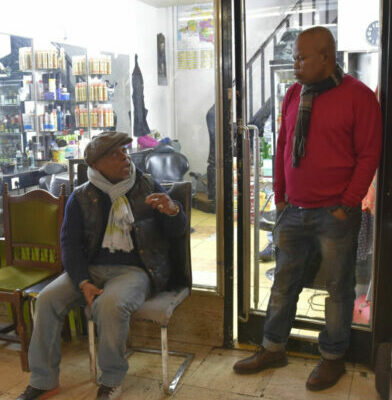
Two hairdressers taking a moment’s break. © Éléonore Talotta.

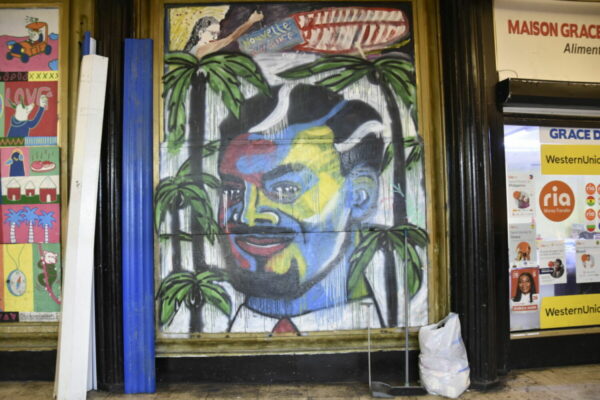
The Matonge neighbourhood is a microcosm of Africa. On the narrow pavement of the Chaussée d’Ixelles, pedestrians almost step on each other’s toes and regularly have to dodge grocery stalls that sell goods imported directly from Africa. Plantains and sweet potatoes sit alongside paprika and sugar cane. Inside the galleries, colourful murals face the many hair salons and clothing and jewellery stores. All this hustle and bustle is accompanied by a backdrop of Congolese rumba and a blend of aromas coming from various restaurants offering specialties.

metaslider id=”7551″

Matonge, a shopping area open to all. © Éléonore Talotta and Nowenn Nkanza Masamuna.

A slice of Kinshasa in Belgium

What Congolese person doesn’t know Matonge? Almost none. “Being in Matonge is like being in Kinshasa,” explains Colette Braeckman, former journalist at the Belgian daily Le Soir and Central Africa specialist. “People say that because Congo was colonized by Belgium. So, when Congolese people left their country, the ‘only place’ they went was Belgium. Nowadays, many Africans have moved away, but the neighbourhood remains symbolic.”

“It’s a real African neighbourhood, it feels like home. There are shops selling traditional fabrics, typical food, and hairdressers who call out to you from the street.” Fabiola, Togolese student

Fabiola is Togolese and lives at the Maison Africaine—a low-cost residence for African students—just a few streets away from Matonge. She arrived in Belgium last September to study Protestant theology at the University Faculty of Protestant Theology (FUTP). After a short stay with her family in Tubize, a town in Walloon Brabant, Fabiola chose to move into the Maison Africaine. She says she does not feel out of place, especially thanks to the atmosphere in Matonge, which reminds her of her own country: “It’s a real African neighbourhood, it feels like home. There are shops selling fabrics, typical food, and hairdressers who call out to you from the street. Above all, it’s a very lively neighbourhood, especially in the evening, because people do their shopping late. But I’m not much of a party girl.”

Matonge, between effervescence and decline

Matonge’s reputation extends beyond Belgium’s borders. According to Colette Braeckman, there is a saying that if you haven’t been to Matonge, you haven’t really travelled, even if you’ve been to faraway countries like Canada and the United States.

‘Overall, there’s a great vibe—a real zest for life, even though the neighbourhood is run down.’ Jason, resident of Ixelles

Jason (not his real name) is a Parisian of Martinican descent. He has been living in Ixelles for a year and discovered Matonge thanks to his uncles, who live in Jette (a different Brussels municipality). Since then, he has enjoyed walking around and observing its unique atmosphere: ‘Overall, there’s a nice vibe—a real zest for life, even though the neighbourhood is deteriorating. Some days, Matonge seems almost empty, even in the middle of the week.’ It’s true that the neighbourhood has lost some of its splendour in recent years. As Ms Braeckman laments: ‘The neighbourhood is not well maintained. In my opinion, Belgium should have developed it better. It remains a national neighbourhood, but there are fewer and fewer Africans. I was angry when housing development projects began to spring up. They distorted its character. Before this turning point, the neighbourhood was an intellectual hotbed.

Memory of the Congolese diaspora

In fact, from the 1960s onwards, the neighbourhood became a hub for the Congolese diaspora. Véronique Clette-Gakuba, a researcher at the ULB’s Institute of Sociology and member of the Présences noires collective, explains that, until that point in time, there were not many Congolese people living in Belgium. It was mainly limited to soldiers during the world wars, or to boys – as the Belgian colonists called them at the time – who came with Belgian families. Things really started to change on 30 June 1960, the date of the independence of the DRC.

As of that September onwards, most of the people arriving in Belgium were scholarship students. They were Congolese, Rwandan or Burundian and often members of the elite in their countries who aspired to help rebuild their countries by returning home once they had completed their higher education in Belgium. The Matonge neighbourhood began to take shape during this period. ‘These students stayed at the Maison Africaine. So, the neighbourhood was initially residential, before shops, bistros and nightclubs frequented and run by Africans opened up,’ recalls Colette Braeckman. Ultimately, many of these students stayed because of political unrest that subsequently broke out in their countries.

Glossary:


Between 1946 and 1974

First Congolese student migrations

30 June 1960

Independence of the DRC

8 February 1961

Founding of the non-profit organisation La Maison Africaine

In the heart of Brussels, Matonge stands as a crossroads where Congolese and Brussels cultures meet. This vibrant neighbourhood in Ixelles (one of the nineteen districts that make up Brussels) is home to members of a Congolese community, some of whom have fled political instability and conflict in the Democratic Republic of Congo (DRC). Today, this place full of life and culture is also a place of resistance and remembrance.

Note: this article was written by students in the ULB Master’s in Journalism programme, under the supervision of Jacques Besnard and Alain Gérard.
From the Roots of the Struggles

In Matonge, Congolese flags are displayed as a sign of solidarity. © Nolwenn Nkanza.

Jean-Paul Mushagalusa Rwabashi left the Democratic Republic of Congo (DRC), but he has never forgotten his country. Born in 1996, in the midst of a rebellion, he grew up with war as a backdrop. Now he is a lawyer, a professor at the Catholic University of Bukavu in eastern DRC and a PhD student in international investment law at the VUB, the Flemish-speaking university in Brussels. However, it is with anguish that he follows events shaking the eastern provinces of the DRC. His family still lives near the airport in Bukavu, an area directly affected by the recent attacks. “Seeing my country attacked time and time again by neighbouring countries hurts,” he says, his voice tinged with bitterness.

From Brussels, where he now lives, Mr Mushagalusa Rwabashi maintains a strong connection with the Congolese community. He sometimes stops by Matonge, the lively African neighbourhood in the city centre, to remind himself of flavours from his country or simply chat with fellow countrymen. Beyond feeling homesick, it is a deep sense of frustration which saddens him most of all.

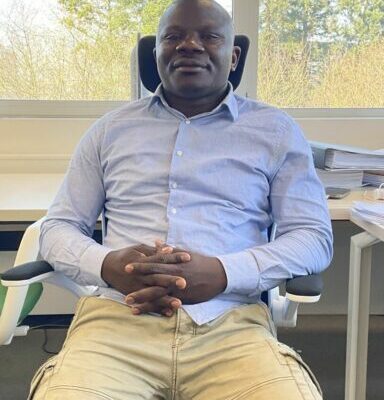
Jean-Paul Mushagalusa Rwabashi, who is not affiliated with any political party in his country, hopes that the situation will one day improve. © Maxime Verbeke.

For him, the war in eastern DRC is primarily the result of poor governance. “Some ministers are richer than the state itself,” he says, exasperated. He points to corruption, which corrodes the government and hinders any effective response to external aggression. He is no longer under any illusion that Kinshasa might be able to take back control. “Talks have failed. Rwanda supports M23. Congo is not capable of managing the situation.”

“I’ve never seen my country at peace.”

He has known fear since childhood. “My whole life has been shaped by conflict. Here in Belgium or in Europe, we can sometimes see sporadic acts of violence, but people generally live in peace. That’s something I’ve never known since I was born. I’ve never seen my country at peace.” Yet, despite everything, he cannot imagine abandoning the DRC. His attachment to his country remains unshakeable. He dreams of returning to his homeland one day, which he considers sacred.

Eastern DRC: never-ending war

The Congolese living in Matonge come from a country that has been ravaged by war for more than 30 years, where instability and violence have continued to worsen in the North and South Kivu regions. The area is a hotspot for recurring conflicts, fuelled by armed groups such as M23. This group, supported by Kigali, has intensified its offensives in recent months, capturing large swathes of territory and heightening tensions. The situation is even more worrying as the Congolese army, poorly equipped and plagued by numerous failures, is struggling to repel the onslaught. Meanwhile, Burundian forces, which had intervened alongside Kinshasa, have withdrawn, leaving a security vacuum.

Benoît Feyt, a journalist at RTBF, the main French-speaking broadcaster in Belgium, who specialises in international affairs and recently returned from a trip to the DRC, describes this war as a “vicious cycle”: “This is not just a local conflict; it is a geopolitical one, fuelled by external interests, particularly those linked to natural resources. The civilian population is the main victim, forced to flee the fighting and live in constant insecurity.”

“This border town is the real gateway to cross between the DRC and Rwanda.”

On maps of the Democratic Republic of Congo (DRC), Goma appears as a strategic city in the far east of the country, on the border with Rwanda. Twinned with Gisenyi in Rwanda, this city is so close to its neighbour that only two customs checkpoints – one “big“, the other “small“– separate them. “This border town is the real gateway to cross between the DRC and Rwanda,” Benoît Feyt says, illustrating the weak security in this area where there is a constant flow of trade. Today, this border town is at the centre of armed conflict. In 28 January 2025, the city fell under the control of the M23 rebels, a group backed by Rwanda, after intense fighting that drove out the Congolese army.

Variations in colour on the map correspond to different populations across regions (in millions of inhabitants).

Control of natural resources: a major issue

The conflict tearing apart eastern DRC is not the result of a recent event but stems from a complex web of historical, political, economic, and ethnic factors. After the fall of dictator Mobutu in 1997 – who had ruled the country with an iron fist for almost three decades – a new era of turmoil began. Laurent-Désiré Kabila, who overthrew Mobutu, found himself confronted with internal conflicts, particularly between ethnic groups and rival political factions. However, what has really intensified the violence in the east of the country is undoubtedly the fight for the control of its natural resources.

“It is a region extremely rich in minerals that is very easy to invade because it is no longer defended.”

Kivu, a province rich in natural resources – especially precious minerals such as coltan, gold and diamonds – has become a battleground for armed groups, fuelling perpetual fighting over control of this mineral wealth. The civil war, which broke out at the same time in neighbouring countries, worsened the conflict by drawing in outside actors, notably Rwanda, which backed several rebel groups. According to Mr Feyt, “it is a region extremely rich in minerals that is very easy to invade because it is no longer defended. M23 enters the country at will.” The journalist goes on to explain that the borders between the Democratic Republic of Congo and Rwanda have become almost non-existent, allowing enemy military groups to enter freely.

A living militant legacy

Patrice Lumumba, Congo’s first Prime Minister and an emblematic anti-colonial figure. © Éléonore Talotta.


Not only is Matonge a neighborhood where the Congolese diaspora can socialize and express their culture, it is a hub of political activism too. The legacy of struggles carried out by previous generations continues to fuel the political demands of today.

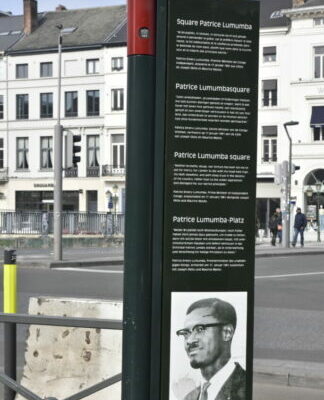
On June 30, 2018, a memorable date marking the 58th anniversary of Congo’s independence, this activism notably led to the inauguration of Patrice Lumumba Square. Located at the corner of Chaussée d’Ixelles and Rue du Champ de Mars, this square pays tribute to the first prime minister of Congo, an emblematic figure in the anti-colonial movement. During the inauguration, Ixelles’s mayor, Philipe Close (Parti Socialiste), explained that Patrice Lumumba shed light on the suffering of his inflicted people under Belgian colonial rule.

Colette Braeckman, a journalist at the Belgian newspaper Le Soir, says: “I think it is scandalous that Lumumba Square is so small. It’s just a small patch of pavement, it deserves more space.”

While this institutional recognition represents a symbolic step forward, it nevertheless remains controversial: “I think it is scandalous that Lumumba Square is so small. It’s just a small patch of pavement, it deserves more space,” says former journalist and specialist on Central African issues, Colette Braeckman (Le Soir). Veronique Clette-Gakuba, a researcher at the Sociology Department of ULB and a member of the collective Présences Noires, points out that anti-racism activists had demanded the creation of a Lumumba Square since the Matonge neighborhood first took shape. It was a founding demand. She laments: “The goal has been achieved, but it is not very satisfying. It’s a place where people pass by in haste — both pedestrians and cars. There is nothing that truly marks this square’s existence in a visible way, such as a statue or a commemorative plaque.”

Patrice Lumumba Square, inaugurated 57 years after his assassination. © Éléonore Talotta.


This criticism carries even more weight when, just a few meters away, the statue of Leopold II — whose reign is closely linked to atrocities committed in colonial Congo — remains visible from Lumumba Square.

The statue of Leopold II vandalized because of his colonial legacy. © Éléonore Talotta.

From outrage to action

In recent years, several protest movements have left their mark on the Matonge neighborhood. In 2020, following the murder of George Floyd, the wave of Black Lives Matter demonstrations — aimed at combating systemic racism against Black people —also reached the Matonge neighborhood. That June, 10,000 people gathered in Brussels. Although the demonstration was organized to speak out against police violence, it was itself marred by clashes between law enforcement and demonstrators in Matonge.

Other demonstrations are regularly organized to speak out against the war in eastern DRC, especially by the Free Congo Belgium collective. The most recent ones, in February and March 2025, condemned Rwanda’s backing of the M23 rebel group and urged Belgian and European authorities to strengthen their support for the Congolese government. Véronique Clette-Gakuba reflects on the police repression seen during these demonstrations: “The police cracked down on the demonstrations. Was this authorized or not? I don’t know, but what is certain is that these gatherings were peaceful at the outset, and the police reacted very brutally.”

Although threatened by gentrification and affected by precarity, Matonge remains a vital neighborhood because it offers a space of freedom and gives the Congolese — and African — diaspora “the possibility to exist”. According to the sociologist: “They can exist without being subject to the white gaze – a gaze which marginalizes and disqualifies when it occupies the center of social spaces.” She concludes: “In Matonge, it is almost totally absent.”

Post-edited translation by Romain Toppets, Helena Docquier, Sarah Marcx and Athanasia-Elpida Siameti (M1 students in translation at ULB) under the supervision of Matthew Langsley