
Voices Rise Up : a collective call from Belgian and Palestinian artists
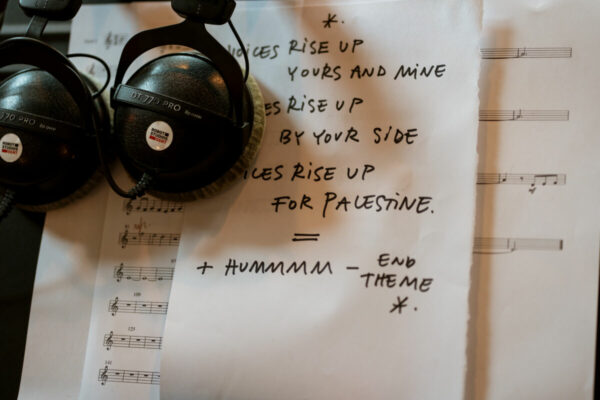
Music plays an important role in shaping public awareness, often turning artistic expression into a form of protest and activism. In March 2026, Oxfam Belgium launched “Voices Rise Up”, a collaborative project bringing together more than fifty Belgian and Palestinian artists in a shared act of solidarity. The initiative comes at a time when violations of international law in the Middle East continue to escalate, with Palestinian civilians bearing the heaviest cost. Through this song, the artists call on the public to speak out, raise awareness, and stand in solidarity with those affected.
More than a musical release, “Voices Rise Up” delivers a clear message: silence is no longer an option. As news of Palestine fades from global headlines despite the ongoing crisis, the project seeks to reclaim public attention and push for concrete political action. By combining music with advocacy, it highlights the urgent need for accountability, respect for human rights, and a meaningful international response.
Focus on Palestinian voices
The Belgian artist and music producer Willem Ardui explained that the project’s main goal was not only to include Palestinian artists, but to give them the space to truly express themselves and share their stories. He added : “The focus should always be on Palestine, and therefore on the Palestinian voices”, noting that his production aimed to support this vision by bringing together a large choir of well-known Belgian artists.
Ardui noted that bringing together more than fifty artists required significant organisational effort, but said the process was made easier by the strong enthusiasm and willingness of everyone involved. He added that it was encouraging to see such a collective desire among the artists to participate and support the Palestinian cause.
« I hope the song shines some light again on the cruelty that is still going on every day in Palestine at the hands of Israel. »
Ardui explained that he incorporated traditional Palestinian musical elements such as the oud and frame drum rhythms to celebrate Palestinian culture and honour its people, particularly in the face of what he described as ongoing attempts to erase their cultural identity. He added that he was fortunate to collaborate with clarinettist Ahmed Hawwash, whose performance brought both emotional depth and instrumental richness to the composition.
He also observed that audience reactions following the release of the song were largely positive, with many appreciating the focus on the human aspect of the project. Rather than reproducing images of violence widely seen in the media since October 2023, he explained that the intention was to highlight the grief and emotional experiences of affected families. Many responses, he said, valued the decision to let Palestinians tell their own stories in their own voices.
Deeply emotional
Ardui described the experience of working closely with Palestinian artists as deeply emotional, noting that hearing their personal stories of loss and hardship was heartbreaking. He said he was grateful for their willingness to share these experiences and declared that the process strengthened his engagement with the issue, reinforcing his commitment to continue supporting the cause through his work.
He concluded : “I hope the song shines some light again on the cruelty that is still going on every day in Palestine at the hands of Israel. I hope people feel empowered to raise their voices, to protest, to start boycotting, and to do everything in their power to put an end to this injustice.”
Words
They cannot leave. No door to run through. No open border. No heaven to protect them. Only collapsing walls, burning air and screaming streets.
Mothers hold their children with arms too small to stop the rockets.Fathers come home with empty hands and eyes full of despair.And children… children learn to die before they learn to live.This is not a war. This is erasing a people from the map.
Gaza has names. Faces. Bodies that were once warm, now cold in the earth.
These are not numbers. These are people. My people.
And their blood cries out for justice.
That is why we raise our voices. For every mother who held her child until its last breath, for every father who was killed while trying to protect, for every child who never got the chance to grow up.
We will keep raising our voices and we will not give up.
This poetic excerpt is part of the song “Voices Rise Up”, performed by Palestinian artist Halah Asfour. She explained that she began writing at a young age and only recently started performing her work publicly. She added that her participation in the project came after being invited by Belgian artists Pieter Embrechts and Willem Ardui, who heard her perform at protests in Antwerp.
She explained : “I just want people not to forget Palestine. Many people believe there is a ceasefire, but they cannot see the reality on the ground. They cannot see the children and civilians enduring ongoing violence and suffering. That is why I speak out and do these things. I do it for my family and for my people in Gaza.”
Asfour described the experience of working on the project as supportive and positive, emphasising the power of art as a tool for expression and connection, especially when addressing wider and younger audiences.
She added that she hopes her words will move listeners emotionally and push them toward action, including raising awareness, participating in protests, and engaging more critically with political realities.
« Why do we raise our voices ? » (Belgian artists)
Singer Laura said : “I think it’s important to use our voices to create more awareness, and not to close our eyes to what’s still happening in Palestine.”
Singer Koen Wauters added : “I think the only thing we can do is speak up so that politicians, maybe on the international level, know that there is support from us for them to go all the way in supporting the Palestinian people. It is too brutal. It is too cruel, what is happening over there. So we have to speak up.”
« If we remain silent, nothing will change, we will just feel powerless. »
According to singer Daan : “Everybody should just acknowledge the fact that there is a genocide; acknowledge that these are criminals who should be held accountable and be locked away.”
And singer Eefje de Visser insisted : “If we remain silent, nothing will change, we will just feel powerless. The song allows us to speak out and be vocal about what is happening.”
A voice of unity and resistance
Palestinian clarinettist Ahmed Hawwash described his contribution to “Voices Rise Up” as an attempt to convey a deeply emotional and sincere response through his instrument. He explained that, for him, the clarinet “speaks directly to the heart”, allowing him to express feelings that words often cannot capture.
Reflecting on the collaborative process, Hawwash described working with Palestinian and Belgian artists as an enriching experience. He noted that each participant brought a distinct musical background and perspective, creating a dynamic exchange that shaped the piece in both challenging and inspiring ways.
He emphasised the powerful role of music in conveying humanitarian and political messages, explaining that while words may have limits, music transcends language and connects directly with human emotion and awareness.
« Even in the darkest moments, there is always a light of hope, and that is what I want to share. »
Regarding the impact of “Voices Rise Up”, Hawwash highlighted its unifying energy, noting that the piece brings people together through shared emotion and collective presence. He stressed that unity lies at the core of the work, giving it its strength.
Hawwash also described music as an enduring form of resistance and expression, stating that it emerges from people’s lived experiences and serves as a means of carrying their stories, emotions, and truths.
He added : “I want people to understand that Palestine is not defined by destruction or war. Its people, its culture, its love, and its resilience define it. Even in the darkest moments, there is always a light of hope, and that is what I want to share.”
Beyond numbers
Another Palestinian artist involved in the project, Alaa Shublaq, who contributed as a singer and composer, said the song carries deep personal meaning for him, as what is happening in Gaza goes far beyond headlines or statistics. He emphasised that it is about real people—families, parents, and children—whose lives have been profoundly affected.
He explained that artists have a responsibility not to remain silent in the face of such realities. For him, music provides a voice through which artists can remind the world of the humanity of people in Gaza, who have dreams, memories, and futures that deserve dignity and protection.
Shublaq noted that the song’s central objective is to ensure that the people of Gaza do not become invisible. Every number reported, he said, represents a human life with a personal story, and the song seeks to shift attention away from abstract figures and political debate toward the lived reality of individuals and communities struggling to survive.
He concluded that while music cannot stop violence, it can serve as a reminder of shared humanity and make it harder to look away.