
AFP Photojournalist from Gaza, Mohamed Albaba, Presents His Work in Brussels
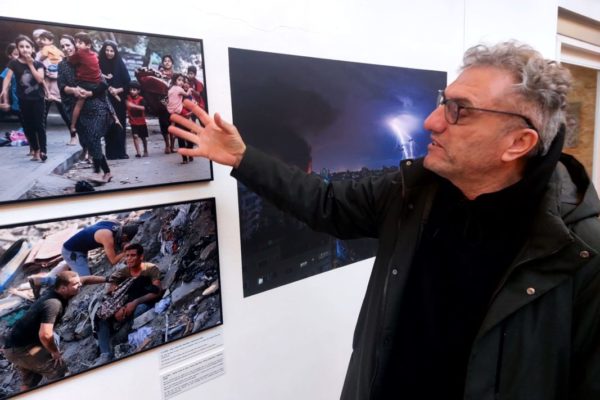
Like other AFP photojournalists, 55-year-old Gaza native Mohamed Albaba is featured at the heart of the exhibition “Inside Gaza’s Inferno” at Géopolis, a center for photojournalism in Brussel. Through this exhibition, he hopes to raise public awareness of the devastating realities of the conflict.
Originally from Gaza, Mohamed Albaba began his career as a freelance journalist in 2000. He quickly became aware of the unique challenges journalists face when working in a conflict zone.
After three years documenting daily life in the Gaza Strip, he secured a contract as a photographer with Agence France-Presse (AFP), becoming a key figure in journalism across the region. His work has taken him through several wars in this turbulent area, as well as major revolutions in Egypt and Libya.
“It was a daily struggle for survival, but it’s part of our reality.”
“I have witnessed many atrocities, but until then, I had never feared for my family or for myself,” the reporter says with determination. His commitment to his profession remains unshakable. During the conflict that erupted after the October 7 attack in 2024, he “spent 225 consecutive days living under constant pressure, without water or food and cut off from the internet,” he explains before continuing. “It was a daily struggle for survival, but it’s part of our reality.”
“As if the sky were crying”
Among his most striking works Albaba singles out a poignant photograph taken five days after the bombings began. “I was on the roof of our office, watching the sky. I saw flashes of light and, at the same time, Israeli planes attacking. I waited for the right moment to capture the image, which to me represents a historic moment. It was as if the sky itself were crying over what was happening below,” he recalls.
“Behind every image, there are lives, stories, and pain.”
Another image will stay with him forever. The photo shows his colleague, Al Jazeera’s bureau chief, desperately searching for his family after losing relatives in the bombings. “That moment made me think about my own family and what I would do in a similar situation. It reminded me that behind every image, there are lives, stories and pain,” he says, his voice heavy with emotion.
After several months of exhausting work under extreme pressure, the journalist decided to leave Gaza. “I begged my organization to help me save my family and myself. After negotiations brokered by Qatar, we managed to leave Gaza for Cairo,” he says, describing the anguish of living in a conflict zone where life can change in an instant.
A plea to the Belgian authorities
It took five months for Albaba and his family, including his wife, daughter and one of his sons, to finally obtain visas for Spain, after several refusals from the Belgian and French embassies in Cairo. His family is currently applying for international protection in Belgium and he is urging the Belgian authorities to help expedite their paperwork.
As for himself, he has chosen not to apply for asylum, fearing it could jeopardize his career as a journalist. “I hope the Belgian authorities understand our situation and help us get the support we need quickly. My family’s safety is my top priority,” he says.
One particularly painful aspect for Albaba is leaving behind his eldest son, who works for a radio station in Gaza. Aged 28, he chose to stay so he could continue informing the world about the situation. “I asked him several times to leave Gaza, but he refuses. He feels it is his duty to report the truth and give a voice to those who have none,” the photojournalist explains, his voice trembling.
This heartbreaking decision highlights the challenges faced by many Palestinian journalists, who must balance their professional duty with their desire to protect their loved ones.
“Every journalist lost is a voice silenced, a story left untold.”
The war in Gaza has consequences far beyond the loss of human life. It has had deep effects on infrastructure, as well as on education and mental health. “Every day, I saw innocent children suffering,” he says. “Schools are destroyed, hospitals are overwhelmed, and families are torn apart. My hope is to see a lasting peace that respects the rights of every individual, not just Palestinians but Israelis as well. Peace is essential for everyone in the region, as it could put an end to unnecessary suffering on both sides.”
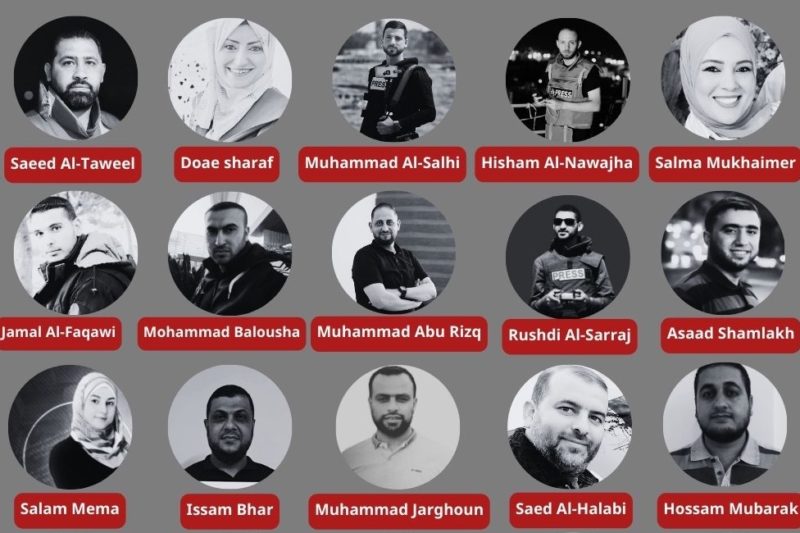
Albaba recalls the tragic loss of more than 200 journalists in the conflict. “I pray for the safety of those still in Gaza, and I hope they can continue their work. Every journalist lost is a silenced voice, a story left untold,” he says, his voice heavy with sadness.
Raising awareness
His message is clear: the quest for truth and peace must continue, even in the face of adversity. By exhibiting his work at Géopolis, Albaba hopes to raise awareness and inspire the world to take action to end the suffering. “We must all unite to defend human rights. Solidarity is our greatest strength,” he emphasizes.
“Through my lens, I hope the world will see our humanity, our struggles and our dreams of peace.”
The importance of journalism in wartime cannot be overstated. Albaba believes that journalists play a crucial role in documenting atrocities and conveying the truth. “Every image I take is a testimony to the struggle of my people. Through my lens, I hope the world will see our humanity, our struggles and our dreams of peace,” the photojournalist concludes.