

Babbelonië: Bringing People Together, Despite Vlaams Belang
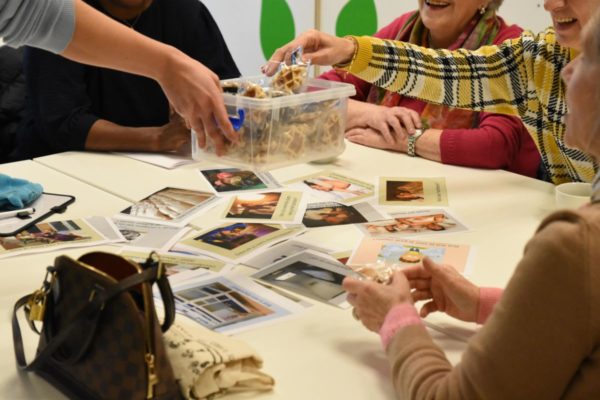
In Ninove, the Babbelonië project brings together participants from all walks of life every week to practise Dutch. The aim of these gatherings is to help foreign residents integrate into their new community. But the initiative has been under threat since Vlaams Belang, which won the municipal elections on 13 October, cut its subsidies. We joined the group for a session marked by both warmth and a growing fear for the future.
A lively buzz fills the meeting room of Ninove’s community centre. Chairs scrape, tables shift. Attending members of Babbelonië, who take part in conversation workshops developed to help foreign residents integrate through language, divide into smaller groups. We join one of them. On the table lies a pile of cardboard cards: each one contains a simple question meant to spark conversation. This week’s theme? Sleep. Heb je goed geslapen? Hoe slaapt een goudvis? Wat is een goed bed?
Participants from all horizons
Five people sit with us to talk. The group is mixed: older and younger participants, native Dutch speakers and newcomers, lifelong residents of Ninove and recent arrivals. Enza, in her sixties, is attending the workshop for the first time. “Actually, it’s the second time,” she says, her French lilting. “I came once last year just to observe.” Enza, a Sicilian immigrant, arrived in Belgium nearly twenty years ago. After living in Brussels, she has now become a Ninovieter (inhabitant of Ninove), with all the linguistic implications that come with it. “I’m currently taking Dutch classes,” she explains. She is a single woman with no real ties in the municipality and adds: “It’s necessary, because at the municipal counters they only serve you in Dutch. But above all, I want to integrate. That’s why I attend the Babbelonië meetings. Learning a language in a classroom is one thing, but nothing compares to practising it in real-life conditions.”
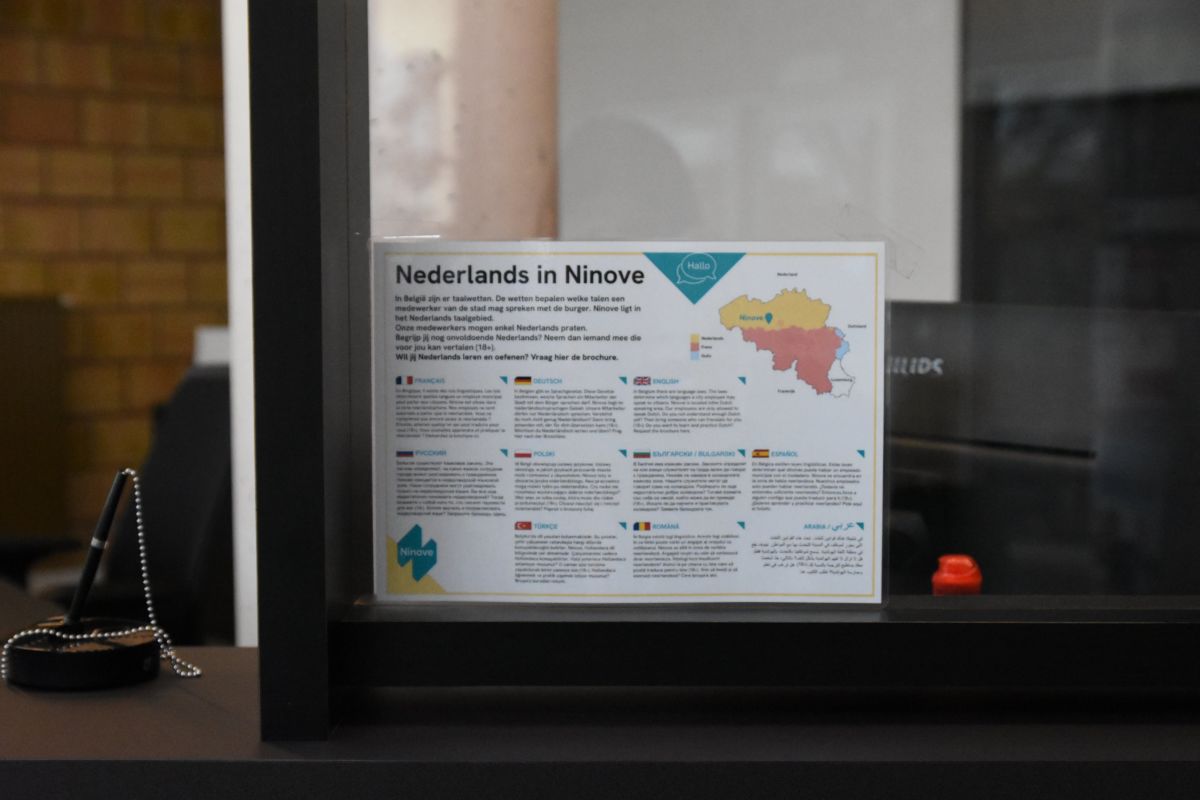
Flanders maintains a strict application of the 1966 law regulating language use in public services.
Across from her sits Camille (not her real name), a regular at the conversation tables. She has lived in Ninove for fifteen years and has “been coming for a few years now.” Beyond the opportunity to practice Dutch, she finds a safe and welcoming space here. “When I arrived in Ninove, I didn’t know anyone. Coming here helped me make friends, because the same people come regularly. Little by little, strong bonds form.” Some members even meet outside the weekly two-hour sessions, not only to speak Dutch but also to find their bearings in a place they barely know.
“Lucien accompanies an Afghan participant, Mohamed. He taught him to drive and helped him obtain his driver’s license. He even helped in the search for a second-hand car to buy. It’s almost like a father-son relationship.”
Conversation flows easily within the group. The atmosphere is relaxed and intimate. Enza, Camille and the other Dutch learners do their best, and so do we. Their Dutch may be hesitant, but that doesn’t hold them back. When they stumble over a word, Annie and Lucien step in to help. Both were born and raised in the region and are now retired, eager to devote their time to a meaningful cause. Annie lives alone; her husband has passed away and her grandchildren are now grown. She has been attending Babbelonië meetings for six years. “I learn so much about other people and their cultures. It enriches me too,” she says.
Lucien has been involved since the very beginning. According to the facilitator, he has been part of the project since its first year, thirteen years ago. He likes to joke around and doesn’t hesitate to tease participants gently. Confident and at ease, he guides the discussion, manages speaking turns and shares personal anecdotes to keep the conversation going. “He brings humor to the group. You have to know how to set boundaries,” says Elke Nopens, the local project manager. “He is always there for others. For example, he accompanied an Afghan participant, Mohamed, teaching him to drive and helping him obtain his driver’s license. They even went car shopping for a second-hand vehicle together. It’s almost like a father-son relationship,” adds Marijke Verleyden, coordinator at Avansa Central Flanders, the organisation behind Babbelonië.
Babbelonië meetings on Fridays are open and participants can attend at their convenience.
Vlaams Belang cuts funding
This atmosphere of support and solidarity is not embraced by all though. In last October’s local elections, Forza Ninove, the local branch of Flemish right wing party Vlaams Belang, won an outright majority. One of the new council’s first decisions, taken in December, was to cut the association’s municipal funding. And this was done without any consultation. “We found out through the press,” recalls Elke Nopens. “It was a very unpleasant surprise.”
Without this funding, Babbelonië’s future is uncertain. “Our umbrella organisation, Avansa, receives funding from the Flemish Community to promote a solidarity-based, democratic and inclusive society. But Babbelonië initiatives depend on financial support from the municipalities where they are based. This funding covers the costs of professional staff who prepare and supervise the activities,” explains Marijke Verleyden.
By withdrawing its support, the team of Guy D’Haeseleer (Vlaams Belang) is putting the project at risk. This comes even though the mayor had campaigned on limiting access to social aid to people with sufficient Dutch proficiency. Ilse Malfroot (Vlaams Belang), alderwoman for Integration in Ninove, justifies the decision by pointing to its cost and attendance figures: “We carried out an evaluation. Only about twelve people attend the workshops regularly,” she says. “Yet the need for Dutch-language learning in Ninove goes far beyond twelve people. That is why we are working on alternatives.”
Instead of funding Babbelonië, Forza Ninove plans to invest in formal language courses, sports-based integration initiatives and everyday community spaces. “Some shops will display stickers saying ‘Hier kan men Nederlands oefenen’ (Here you can practise your Dutch),” the alderwoman notes. She firmly refuses, however, to provide any timeline: “We have six years to implement our policy.”
Despite collective action, the future remains unclear
Her arguments fail to convince. “We received €11,000, a small proportion of the municipal budget!” says Elke Copens. “And it is naive to think people can learn Dutch through apps or when they’re buying bread at the bakery.” During a meeting with Alderman Malfroot, Babbelonië participants were also able to explain why the project matters to them. “At first it was mostly the native Dutch speakers who were complaining,” the facilitator recalls. “But then other participants also spoke up. They told her their stories. It was really brave of them.”
Camille agrees: “I don’t want this to stop. It would be a huge loss for many people here. I’m glad we spoke out. In a society that insists newcomers must integrate, Babbelonië clearly has its place.”
The backlash has extended far beyond the local group. The cut in funding sent shockwaves throughout Flanders. “Every day we received emails from strangers asking how they could support us. So we launched a crowdfunding campaign. To our surprise, in just fourteen days we raised the equivalent of our municipal subsidy,” says Marijke Verleyden. Babbelonië Ninove is safe — for now. But in a year, the threat of closure will return if no structural funding is found. “Several options are being explored, but no long-term solution exists yet,” the coordinator notes. “At least the venue is still ours,” she adds wryly.
Does this mark the beginning of a wider trend in Flanders, as the far-right gains ground? Not necessarily. In Izegem, the nationalist alderman has instead announced increased support for the local Babbelkamp initiative. Officials insist the context there is different. Still, Vlaams Belang’s first decisions in Ninove raise questions.
Enza, Camille, Annie, Lucien and the twenty to thirty weekly attendees are unanimous: they will continue to fight for their Friday morning meetings. “In today’s society, where newcomers are expected to integrate, Babbelonië absolutely has its place,” they affirm, convinced that language should bring people together, not drive them apart.
Post-edited by Elise Devis (M1 student in translation at ULB) under the supervision of Sonja Janssens