
Containing Extremism: A Survival Tactic in Post-Assad Syria
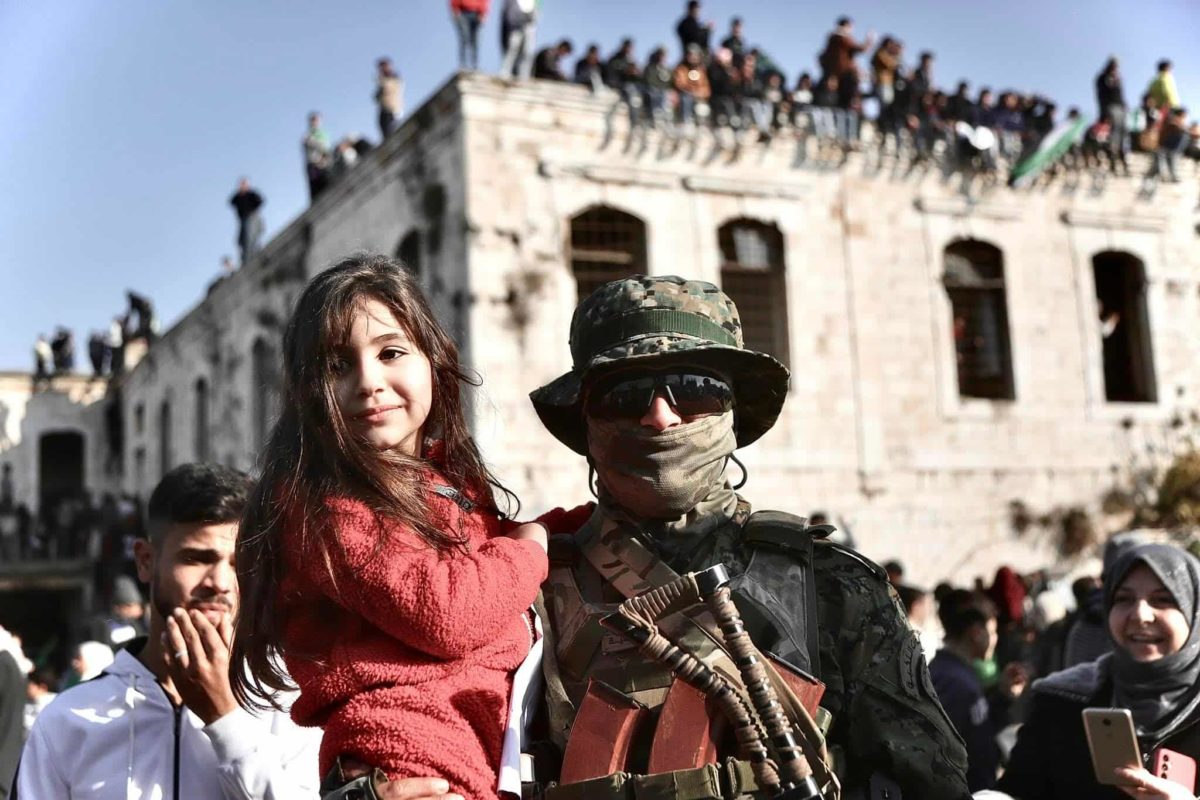
The West has always fought terrorism with war. However, the new Syria is focusing on integration rather than exclusion. This is reflected in the policy of naturalizing foreign fighters listed on international terrorism watchlists.
The West has always fought terrorism with war. However, the new Syria is focusing on integration rather than exclusion. This is reflected in the policy of naturalizing foreign fighters listed on international terrorism watchlists.
The fall of Bashar al-Assad’s regime at the end of 2024 did not end the Syrian conflict but rather reconfigured it, raising new questions: how can the institutions of the “new Syria” be built on a legacy of bloodshed and division? And is containing extremism a means of strengthening the state, or, on the contrary, of undermining it?
In this context, neither justice nor reconstruction appears to be an immediate priority. What takes precedence is mastering what cannot be prosecuted and containing what cannot be abandoned.
The Damascus Moment
The West has always fought terrorism with war. However, the new Syria, as demonstrated by President Ahmed Al Sharaa’s statements and actions, prioritizes controlling behaviour over confrontation, and integration over exclusion. This is reflected in the policy of naturalizing foreign fighters listed on international terrorism watchlists. Those who fought in the ranks of the revolutionary factions are now integrated into state institutions and have been granted legal status.
A Policy of Fait Accompli
In an interview with Reuters on December 29, 2024, President Ahmed Al Sharaa stated:
“We cannot ignore the presence of foreign fighters. Some have been here for years. We have a duty to supervise them, not exclude them blindly. Integration is part of the security solution, not a political reward.”
According to a Reuters investigation published on June 2, 2025, the Syrian leadership, with the tacit approval of the United States, has implemented a plan to incorporate around 3,500 former foreign fighters into a new unit, the Syrian Army’s 84th Division. The U.S. special envoy to Syria, Thomas Barrack, called the measure a “concrete action” after meeting President Al-Sharaa, commending “the steps taken with regard to these foreign fighters”.
Despite the difficulty of this decision, Western capitals have remained silent. Far from being unintentional, this silence, can be interpreted as implicit consent—provided stability is not compromised.
The Fighter’s Place in National Identity
This policy has sparked intense debate across Syrian society. Many wonder why foreign fighters are granted citizenship, while Palestinians born on Syrian soil for generations are denied it. The case of actor Ayman Reda, born to a Syrian mother and an Iraqi father, is often brought up. Despite his long-standing presence in Syrian cultural life, he still does not have citizenship. This gap highlights the tensions between military recognition and the right to civilian status.
This debate reflects a deeper division: should citizenship be based on belonging to a society or having made a military sacrifice?
These questions have not remained purely theoretical. They are echoed by Syrian activists such as Ahmed Kalash, a political activist, who believes that “the naturalization of foreign fighters is based on legitimate legal and humanitarian grounds.” After spending many years in Syria and taking part in the revolution, these men meet the integration criteria recognized in many countries that respect the rule of law.
“This is not just about numbers, but about the political significance of such a decision.”
However, Kalash warns against integrating them into the state’s decision-making spheres, which he sees as a silent redefinition of the balance of power in post-conflict Syria. “It amounts to an institutional legitimization of forces that, until now, were only peripheral players on the battlefield,” he argues. According to him, such an approach profoundly reshapes the balance of legitimacy by marginalizing Syrian fighters who were at the very heart of the struggle and carried a founding revolutionary legitimacy.
He also rejects the comparison sometimes drawn with Palestinians who have lived in Syria for decades, emphasizing that the context is very different and that the Palestinian question remains fraught with its own political and historical complexity. The mass naturalization of Palestinians would not be perceived as an impartial administrative act, but as a symbolic upheaval of the state’s identity structure. “It’s not just about numbers,” he concludes, “but about the political significance of this type of decision at such a critical stage of national reconstruction.”
Quietly Reshaping the Regional Balance
This policy is not limited to a domestic framework; it also fits within a carefully calibrated regional balance. According to Turkish Defense Minister Yaşar Güler (June 4, 2025), Ankara has begun providing military training and advisory services to the new Syrian army, while maintaining a deployment of more than 20,000 Turkish soldiers on Syrian soil. The minister stated that “Turkey’s top priority is to preserve Syria’s unity and territorial integrity.”
This position is reinforced by a RUSI analysis on January 13, 2025, which states that Turkey supports the “consolidation of post-regime Syrian institutions” by facilitating the integration of groups such as Hayat Tahrir al-Sham (HTS), which played a central role in the fall of the previous regime. This strategy aims to stabilize the country while retaining a degree of direct influence in the northern regions.
Despite its own delicate situation, Iran has remained publicly silent on the integration of Sunni fighters into the state apparatus. Russia, for its part, is focused on preserving its presence and interests, showing little concern for the naturalization of jihadist fighters. Meanwhile, the Gulf countries watch with concern as Damascus gradually emerges as a potential safe haven for former fighters.
European Concern
No other recent situation comparable to Syria has ever been recorded: a state that naturalizes and grants secure positions to foreign fighters — some of whom are listed on terrorist watchlists. This unique act in the contemporary history of conflicts combines strategic audacity with imminent risks.
According to the European Parliament, in a resolution adopted on February 11, 2025, any gradual lifting of sanctions against Syria was clearly conditioned on the rigorous management of security issues, the preservation of the country’s territorial integrity, and the protection of minorities. It also emphasized the explicit exclusion of former foreign fighters from positions of power, except under strict international supervision.
In Belgium, the Minister of Foreign Affairs stated on January 3, 2025: “The current Belgian government will not make any decision regarding the repatriation of foreign fighters from Syria. Such a decision must be taken by a fully constituted government.” These positions reveal a persistent tension between security imperatives and institutional constraints within the European Union.
European states, especially Belgium and France, find themselves in a difficult position: unable to prosecute returnees due to the lack of tangible evidence, yet at the same time concerned that Damascus could become a legalized safe haven for them — a balancing act that swings between powerlessness and anxiety.
Taming Necessity
Ultimately, containing extremism in Syria is not a surrender, but an attempt at controlled containment. It is a pragmatic taming of necessity, not an ideological alliance. A choice that may affront European sensitivities, but which, for a Syria in the making, could well be the only viable way to preserve the state in light of the legacy of its conflict.
Post-edited translation by Akansha Chartier and Mihaela Romascanu (M1 students in translation at ULB) under the supervision of Matthew Langsley