
Female journalists in Turkey defy repression
In Turkey, female journalists, particularly Kurdish women who oppose the government, are creating an alternative media outlet by adopting language that challenges the sexism of the pro-government press. Yet this choice comes at a high cost: arrests, detentions, harassment, intimidation, difficult working conditions, and discrimination.
Several women’s organisations are actively fighting against the pressure exerted on Turkish journalists and often publish reports on this violence.
On 7 October 2023, Kurdish journalists founded the Mesopotamian Women Journalists Association (MKG), the first of its kind in Turkey. This association continues the work of the Mesopotamia Women Journalists Platform (MGKP), established in 2017 by around 50 journalists.
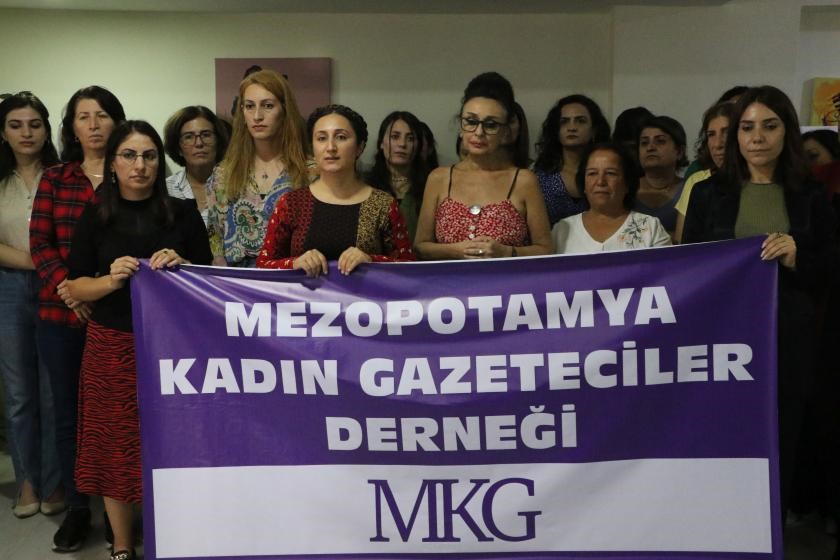
The association plays a significant role in monitoring, documenting, and defending the rights of women journalists. Its actions and objectives include strengthening skills through training and workshops, supporting young journalists, creating employment opportunities, building solidarity networks, and promoting language based on gender equality in the media.
39 journalists, including 7 women, in prison
In October 2024, the association reported that six female journalists had been arrested, five threatened, and three physically attacked. The same report recorded 126 instances of online content censored and ten broadcasting bans. In total, seven female journalists were imprisoned in October. The report stressed that “restricting public access to information reinforces government censorship and prevents society from accessing the truth.”
According to the Dicle-Firat Journalists’ Association, 38 journalists were in prison at the end of October. Within one month, 104 journalists had been prosecuted in 39 separate cases, with eleven of them being sentenced to a total of 19 years and 8 months.
Harsh working conditions
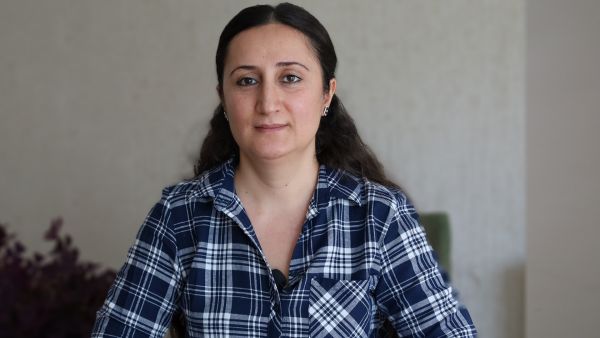
In an interview with Latitudes, the media outlet of the University of Brussels (ULB), the association’s president, Roza Metina, described the pressures faced by women journalists in Turkey, their working conditions, and their struggle. She emphasised that repression cannot be measured solely by the number of arrests, stating: “In a country where journalists cannot work freely, there is no democracy. Where there is no democracy, women journalists cannot freely exercise their profession.”
Roza Metina criticises the sexist language used by the pro-government press, which she believes legitimises violence and trivialises women’s issues: “By repeating sexist rhetoric, it paves the way for violence against women and turns female journalists into targets.”
“Female journalists are also targeted because they fight against sexist language in the field.”
Roza Metina continues: “These acts of violence become tabloid material. Women journalists are also targeted because they challenge sexist language in the field. Attempts are constantly made to reduce the areas in which women are active. For example, the Istanbul Convention was cancelled in the middle of the night by President Tayyip Erdogan – a man. Laws protecting women and children are either abolished by men or turned into bargaining chips by parties formed through male alliances. Women journalists who report on these issues to the public are criminalised by the state.”
She cites the example of Rabia Önver, a journalist with the Kurdish media JINNEWS whose home was raided following her report on drug trafficking and prostitution in Hakkari, a Kurdish-majority area of Turkey. While the journalist is being prosecuted, those involved in these activities remain unpunished.
Fear of women’s power
Repression is not only targeting Kurdish journalists, explains Roza Metina. Any journalist who is against Erdogan’s government is “systematically prosecuted.” She points out that many journalists are prosecuted because of their reports and posts on social media, with some accused of “insulting” state officials, including the president.
Roza Metina adds that Kurdish women journalists, historically shaped by resistance, are targeted because of their identity and their attachment to their language and culture. She observes that officials fear their strength as women and seek to make them less economically independent, by pushing them to abandon their profession.
Women journalists also suffer degrading treatment in prison, and Roza Metina lists some of the most worrying examples. Esra Solin Dal, a journalist with the Kurdish news agency Mezopotamya (MA), was subjected to a degrading body search in prison. Elfazi Toral, a journalist with JINNEWS, the only all-women news agency, was beaten inside a police vehicle during her arrest and still suffers from the consequences. And on 3 May, World Press Freedom Day, Dicle Müftüoğlu, editor-in-chief of Mezopotamya and co-chair of the Dicle-Fırat Journalists’ Association, was handcuffed for 15 hours during her transfer from Diyarbakır to Ankara and deprived of food for 24 hours.
Inhumane treatment
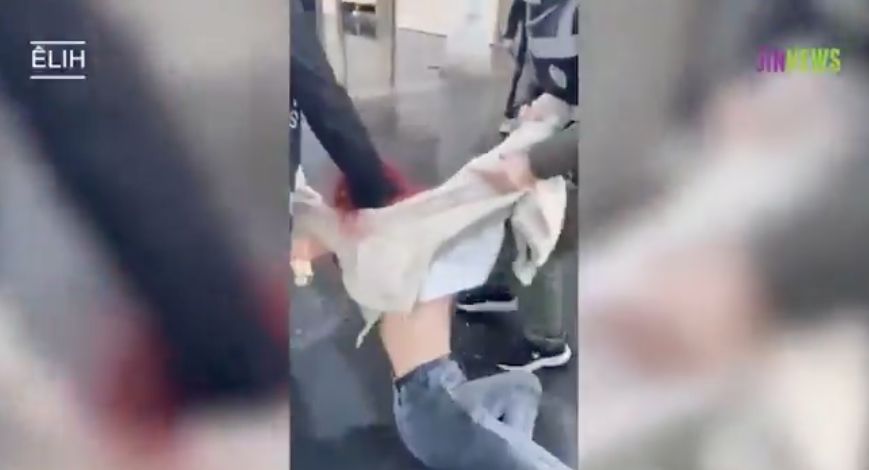
Repression and police violence against women journalists continued in November. On 5 November, Pelşin Çetinkaya, a journalist working for JINNEWS, was violently arrested by Turkish police while she was covering a demonstration in the Kurdish city of Batman, before being released later that day.
The Mesopotamia Women Journalists Association condemned this “inhumane treatment”. Videos posted on social media showed the journalist being pulled to the ground by law enforcement officers.
Gender inequality and female solidarity
In Roza Metina’s view, a gender gap persists in journalism: “Female journalists face obstacles that their male colleagues do not, and society does not accept women working at night as they do for men.” Difficulties include housing problems and increased vulnerability to racist and sexist attacks.
Despite this climate of fear and repression, women journalists in Turkey are developing solidarity networks to continue their work, gathering under platforms such as JINNEWS and the Mesopotamia Women Journalists Association. These groups also organise events in support of their imprisoned female colleagues.
Assassinations beyond borders
While the press in Turkey faces increasing pressure, deadly attacks are also targeting Kurdish female journalists abroad. Nagihan Akarsel, a journalist and researcher in “jineology” – a school of Kurdish feminist thought – was murdered on 4 October 2022 in Iraqi Kurdistan. The Turkish Government is suspected of being behind the attack.
“As Kurdish journalists, we will continue to defend these fundamental rights.”
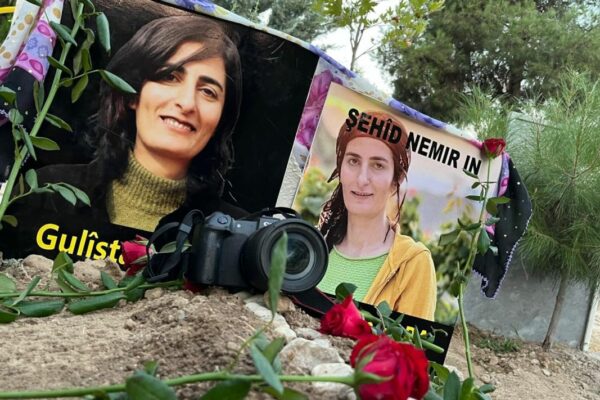
Journalist Gülistan Tara and her colleague Hero Bahadin were killed on 23 August 2024 by a Turkish drone in the province of Sulaymaniyah. Audrey Azoulay, Director-General of UNESCO, condemned these murders and called for a thorough investigation.
.
Roza Metina concludes: “These attacks are an assault on the tradition of freedom of the press. They target Kurdish identity and society’s right to access information without any limit. As Kurdish journalists, we will continue to defend these fundamental rights.”
Post-edited translation by Sarah Marcx (M1 student in translation at ULB) under the supervision of Matthew Langsley