
Femicide in Turkey: invisible even in statistics
According to the platform “We Will Stop Femicide” (KCDP), during the first nine months of 2024, at least 295 women were killed by men and 184 women died under suspicious circumstances.
According to the We Will Stop Femicide Platform (KCDP), at least 295 women were killed by men and 184 women died in suspicious circumstances in the first nine months of 2024.
In Turkey, each month, dozens of women are murdered by men or die in suspicious circumstances. In recent years, the number of femicides has increased sharply, yet public authorities still do not keep official statistics on violence against women.
Data from women’s rights organisations paint an alarming picture. According to the We Will Stop Femicide Platform (KCDP), in the first nine months of 2024, at least 295 women were killed by men and 184 women died in suspicious circumstances.
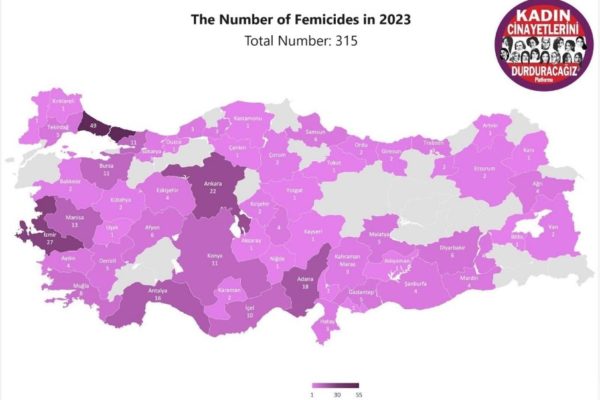
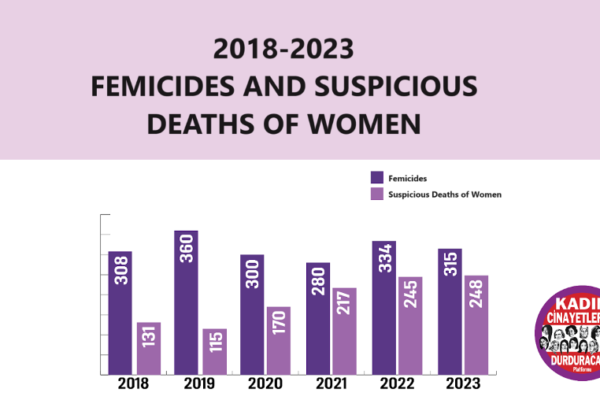
In the first six months of the year, 205 femicides and 117 suspicious deaths were recorded. By comparison, before Türkiye withdrew from the Istanbul Convention, in the first half of 2021 131 femicides were reported. This number rose to 164 in the first half of 2022 and 147 in the first half of 2023, for a total of 315 femicides and 248 suspicious deaths in 2023.
The KCDP holds the authorities accountable for these unsolved suspicious deaths. According to the organisation, as long as the suspicious deaths are not resolved and investigations are not conducted effectively, perpetrators of violence will not be deterred.
In 2024, feminicides involving firearms increased at an alarming rate. The KCDP reports that 12% of murders in the first half of 2024 were committed with firearms. It stresses that ‘the increase in deaths by firearms is the result of the uncontrolled proliferation of small arms and light weapons.’
No official statistics
An independent civil society organisation, KCDP has been collecting data on violence against women since 2010. Ensuring the protection of women against violence, KCDP provides legal assistance to women in need of protection, supports the families of victims and fights for legislative changes to protect women.
“Identifying a problem requires data.”
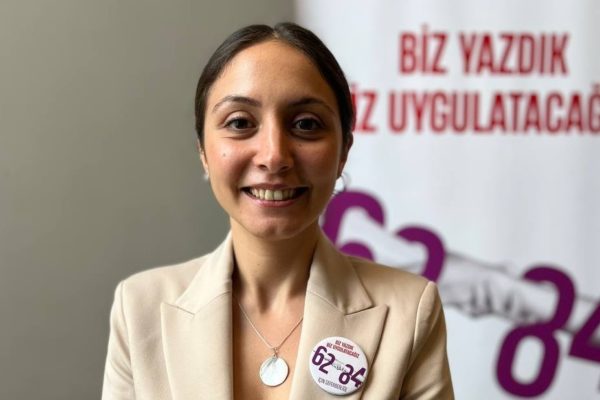
In an interview with Latitudes, KCDP representative and lawyer Esin İzel Uysal explains: ‘Since the organisation was founded, we have been asking the relevant ministries if they have data on femicides. However, the reality is that the state does not even maintain such records.
According to her, public authorities do not even recognise violence against women as an issue worth tracking in official statistics. “Identifying a problem requires data. To address the lack of information, we took the initiative to collect it ourselves when we realised that there were not official records.”
Withdrawal from the Istanbul Convention
Violence against women has increased since Türkiye’s official withdrawal from the Istanbul Convention by the AKP government on 1 July 2021. Yet Türkiye was the first country to sign the Convention on 11 May 2011 and ratify it on 24 November 2011. The Istanbul Convention, adopted by the Council of Europe and signed by 45 countries and the European Union, sets standards for preventing and combating violence against women and domestic violence.
‘The Convention served as an important safeguard for women.’
‘Since the withdrawal from the Istanbul Convention, we have seen an increase in violence against women, femicides and suspicious deaths,’ explains Esin İzel Uysal.
She adds: “If we take a look at the yearly statistics, the only decline occurred in 2011, the year the Convention was signed. The act of signing alone gave women courage and deterred men from resorting to violence, which reduced the number feminicides. Since the withdrawal, violence has increased again. The Convention was an important safeguard for women. With its withdrawal, men have been encouraged to act without fear.”
Suspicious deaths
The KCDP also reports an increase in suspicious deaths in recent years. Esin İzel Uysal explains: “There has been a marked increase in suspicious deaths, directly linked to the policies carried out by the authorities. ”
Why talk about ‘suspicious deaths’? “A death is considered suspicious when it cannot be determined with certainty whether it was a femicide, a suicide or a natural death. A thorough investigation is therefore essential to determine the cause of death. We include these data in our reports, but the authorities do not use the precise term and make very biased statements about femicides. Suspicious deaths do not appear in official statistics or in official statements.”
Factors that exacerbate violence
Esin İzel Uysal emphasises that violence against women is not specific to any particular social dynamic, culture or region. ‘Inequality exists everywhere in the world,’ she says, comparing violence in Türkiye to that seen in some Latin American countries. According to her, even if social factors play a role, violence cannot be explained solely by cultural codes: “Gender inequality is the root cause. We are talking about deep-rooted inequality. ”
‘Social class does not shield anyone from violence.’
The KCDP representative also emphasises the impact of government policies and economic conditions. “Whether she is a labourer, unemployed, highly educated or not, a woman is exposed to violence and discrimination. Social class does not shield anyone from violence. ”
During periods of economic hardship, women are often the first to lose their jobs. “They are considered secondary earners in households. This means the loss of their economic independence,” states Esin İzel Uysal.
What measures are the authorities taking?
Faced with increasing violence, what measures are the Turkish authorities implementing? “Inequality runs very deep. Creating a society where violence cannot emerge is a political choice. The roles assigned to women, the place of men within the family, all of this can be changed,” says the KCDP.
“This national law is essential, yet often overlooked.”
Although Türkiye has Law 6284 on the protection of women against violence, its enforcement remains inadequate. “This national law is essential, yet often overlooked or poorly enforced, contributing to the persistence of feminicides,” says Esin İzel Uysal.
Furthermore, sentence reductions granted to perpetrators of violence for ‘good behaviour’ or for reasons such as wearing a tie in court encourage such behaviour. “If the law were strictly enforced, it would be a big step forward.”
The role of civil society organisations
Women’s rights organisations play a crucial role in combating violence against women in Türkiye. “Türkiye has significant experience in this area, with a strong feminist movement. We are trying to mobilise as many people as possible for this fight,” concludes Esin İzel Uysal.
The role of the media
Finally, the KCDP representative emphasises the importance of the media: “Nowadays, the media are progressively adopting the terms ‘femicide’ and ‘suspicious death’ instead of ‘crime of passion’. This allows us to raise public awareness more effectively. The media play a crucial role in relaying our messages.”
Post-edited translation by Pierre FRANÇOIS-XAVIER (M1 student in translation at ULB) under the supervision of Sonja Janssens