
Haiti: Women’s Bodies Turned into Battlegrounds by Armed Gangs (Podcast)
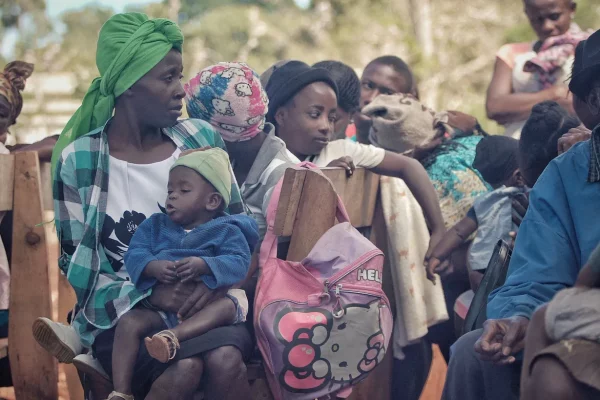
Haiti is facing an explosion of gang-related violence. In 2023, Haitian journalist Jean Samuel Mentor went to Source-Matelas, north of Port-au-Prince, to meet the victims of a massacre. Audio report.
According to the United Nations, 130 women have been abused in repeated gang rapes in Haiti’s poor neighbourhoods over the past nine months. Sexual violence is used by armed groups as a weapon of war during their assaults and slaughters.
The 19 April 2023 attack in Source-Matelas left 29 women victims of gang rape, as revealed by Haitian NGO Réseau National pour la Défense des Droits Humains (RNDDH). Reporter Jean Samuel Mentor went to meet the victims of this latest massacre.
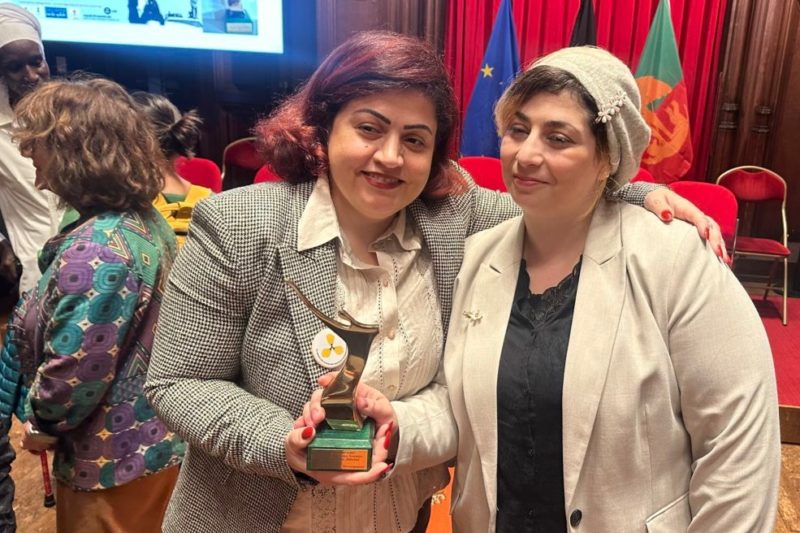
The audio report accessible just below won third place at the Bayeux Calvados-Normandy Awards for War Correspondents, in the radio category. It was first released in 2023 on HaitiNews2000, an online media outlet with Mentor as editor-in-chief. Jean Samuel Mentor also received Haiti’s second prize for young journalists.
To better understand the situation, here is Jean Samuel Mentor’s account:
Located in the municipality of Cabaret, some 30 kilometres north of Port-au-Prince, Source-Matelas has become a like cemetery without graves. This contrasts with that area’s mainly agricultural background. Some industries have also been active there for years, such as the private port of Lafiteau—owned by businessman Gilbert Bigio—, Moulins d’Haïti (Windmills of Haiti) and the National Cement Plant, as well as various commercial and health centres.
Images of devastation
This place used to be the perfect image of a quiet town. But for several weeks now, barefoot corpses have remained scattered across the area, spreading a foul smell all around. More than a hundred people have been beheaded, shot or burnt alive inside their homes. The scenes are of utter devastation. After several attempts, the gangs that had been eyeing the town for months eventually launched their offensive.
Cinq secondes and Talibans, two very powerful heavily armed groups active in the country’s Western Department, have seized control of the town, making it difficult to enter as anything that moves gets shot at. On the main road to Source-Matelas, a sense of fear is always there. Inside the now-deserted town, the smell of death lingers in the air. Just a few metres away from these warlords, an armoured tank patrols but does not intervene. Its presence is unsettling.
Most of the population has taken refuge in a public square 2 kilometres away. Despair and anguish are written on everybody’s face. No one knows where to go. Even this shelter is at risk, for armed groups intend to extend their control over the whole of Cabaret. At 6 p.m. a farmer arrives in a van to give out a few mangoes to the displaced. “That’s all I’ve got, I can’t give more. Our harvest is spoiling and we can’t sell them in the capital or in other cities. Gangs control everything,” says the man, who seems to be in his fifties.
All local businesses have had to close since the town was seized. Practically no one uses the main road anymore. “This is exactly what they wanted: to control Source-Matelas in order to extort local businesses,” explains Marie-Yolène Gilles, director of Haitian NGO Fondasyon Je Klere.
She also says that, while it is difficult to establish a definitive death toll as long as gangs are still present, the number of deaths and disappearances is about a hundred, according to a provisional estimate. She further clarifies: “The Haitian Red Cross and the Directorate of Civil Defence are unable to provide first aid to the injured.”
The residents’ squad
To understand what triggered the slaughter, we must go back a few days. In order to defend themselves against the frequent raids and assaults, local residents had formed an anti-gang squad. But at dawn, on the very day they were about to inaugurate a police substation in Gran-Chimen—an area within Source-Matelas— to boost police presence in the area, gangs carried out a raid, armed with enough weapons to wreak havoc on the town. At the end of the first day of attack alone, a dozen people had already been killed, says Joseph Jeanson Guillaume, Cabaret’s interim mayor.
“Since then, the number of deaths and disappearances has increased every day. If the national police took stronger action, the human toll would be lower,” he laments.
Guillaume is not the only one criticising the police. In their fight against gang violence, locals had equipped themselves with an arsenal comprising machetes, knives, homemade weapons and old rifles, among others. All the same, they knew that their enemies had access to much bigger calibers. So did the local police, who nevertheless disarmed the members of the anti-gang squad just two days prior to the attack, according to a survivor wishing to stay anonymous.
The gangs took this opportunity to systematically slaughter the inhabitants. According to Fondasyon Je Klere, thirteen members of the same family – the Joachims – were killed that day, while another family with eight infants, fleeing in a small boat, drowned. The NGO has published a report summarising the different massacres perpetrated in Haiti over the past 21 months.
“I can’t take it any more. I feel powerless.”
Three weeks after the carnage a new gang leader was appointed in Gran Chimen while local police forces remain still absent. According to Joseph Jeanson Guillaume, although an armoured tank is patrolling the main road, no operation has yet been launched to retake the town.
The government has also been idle so far, as neither the Prime Minister or any minister has condemned the atrocities committed that day or announced measures to restore order. We attempted to contact the Haitian National Police spokesman, Senior Officer Garry Desrosiers, to ask him when they plan to take back control, but to no avail.
The authorities in Cabaret are overwhelmed and do not know who to turn to for help. Joseph Jeanson Guillaume admits he is unable to change things: “I can’t take it any more. I feel powerless seeing all these people dying and fleeing their homes. There are children, elderly people… I can’t take it anymore,” he says, also blaming the government for abandoning the most vulnerable.
“Now the whole town is fleeing”
Civil Defence technical coordinator Rivélino Valciné also confesses he can’t assist the victims and the displaced.
“During the first attack in Source-Matelas, we had already taken in about fifty people under our care, whom we’d gathered in the Cabaret National School. But we were unable to provide them with any real kind of assitance. Now the whole town is fleeing and Civil Defence cannot possibly support over 300 households.”
The victims’ lasting pain
“I was raped by four different men. The first one chose me because they couldn’t find my daughter and so raped me instead. They also shot my little brother through the heart. And then four young men raped me in front of my children…”
This account is made by a woman we will call Jacqueline, a 38-year-old survivor taking shelter in a public school with over a hundred other people, mainly women and children. Among them, several mothers were subjected to gang rapes in front of their children, just like her. RNDDH registered a total of 29 such victims in the 19 April massacre.
“They murdered and burnt my husband before my very eyes, then raped me in front of my children”
A few steps away from Jacqueline, six other women are in conversation. None of them wants to talk about that day of sheer horror, except Jana (also a pseudonym), who speaks in their name:
“They murdered and burnt my husband before my very eyes, then raped me in front of my children, who were screaming. Three men told me to run so I managed to escape with my kids. The next day I saw that our house had been reduced to ashes,” she says, adding she has felt constant pain in her lower abdomen ever since.
According to RNDDH, the abuse inflicted on women’s bodies is used as a weapon in the series of slaughters perpetrated in Haiti. Marie Rosie Auguste Ducéna, one of the organisation’s leaders, adds that the collective raping of women and little girls is a common gang practice.
“We will never know exactly how many people were killed, how many women raped or how many houses burnt down, because gangs rule this area and the police are absent—or, at least, fear to venture in Source-Matelas,” she sarcastically comments.
Ten days after the attack, some families fled the municipality to take shelter in the north while others, having nowhere to go, organised themselves to try and snatch back control with an operation called “Bwa Kale”. This Creole slogan, which cannot be easily translated, refers to a vigilante movement aimed at driving gangs away through violent means. However, this initiative has gone sour, causing three people to die. Between April 2022 and April 2023 thirteen large-scale massacres and armed assaults were recorded in the country.
Post-edited translation by Gaël Roumegoux (MA1 student Translation at ULB) under the supervision of Sonja Janssens