
The Press in Guinea: Silence Under Watch
Since the coup d’état on September 5, 2021, the military junta has stepped up censorship measures in Guinea. Although the transitional regime made promises, the situation on the ground reveals a troubling regression, marked by repression, censorship, and fear permeating newsrooms.
On February 4, 2025, the Guinean Press Professionals’ Union (SPPG) sounded the alarm by presenting its third annual report on press freedom. Simply titled “Year of Obscurantism in Guinea”, this report highlighted a worrying deterioration in the conditions under which journalism is practiced in the country.
The figures speak for themselves: between January 1 and December 31, 2024, violations of Guinean journalists’ rights rose significantly. Seventy serious violations of press freedom were reported, marking a staggering 204% increase compared to 23 cases documented in 2023.
It’s not just a number; it’s a wake-up call in Guinea. Thirty-two journalists were detained, among whom 16 were arbitrarily arrested, including two who were imprisoned at Guinea’s most dangerous prison, the Maison centrale de Coronthie. In addition, two journalists from a public media outlet were violently assaulted by members of the military in the capital, Conakry, leaving one with a dislocated shoulder. On December 3, another journalist was kidnapped near the city, while four others were forced to flee the country amid escalating threats.
The report also reveals that two of the three legal proceedings brought against journalists are based on the Criminal Code, thereby circumventing the press freedom law intended to protect these professionals from imprisonment.
An Increasingly Tense Political Context
Following Decision No. 686 of May 21, 2024, issued by the Ministry of Information and Communication, four radio stations (Djoma FM, FIM FM, Sweet FM, Espace FM) and two private television channels (Espace TV, Djoma TV) were shut down.
This closure comes amid an unprecedented crackdown on press freedom. The ruling military authorities officially justified these closures on the grounds of “non-compliance with the specifications of their licenses” or, in certain regional cases, the illegality of broadcasting without official authorization.
Since November 2023, several media outlets have remained inaccessible without a VPN and have already been subject to jamming and access restrictions. The Guinean authorities have also enforced internet shutdowns and blocked news websites, citing “national security” reasons. On the ground, however, these measures primarily target the most widely followed and most critical media outlets of General Mamadi Doumbouya, the transitional president, drastically curtailing media pluralism and putting hundreds of professional journalists out of work.
The International Federation for Human Rights (FIDH) condemns this worrying attack on freedom of speech and highlights the fact that the Republic of Guinea is a signatory to binding international and regional treaties guaranteeing press freedom and freedom of speech. Furthermore, Articles 8, 21, 23, and 24 of the Transition Charter of September 27, 2021 call for strict respect for these rights and freedoms.
Reporters Without Borders (RSF) has denounced a clear intent to silence all dissenting voices in Guinea. This wave of closures comes as General Mamadi Doumbouya extends the transition period and bans all demonstrations, amid a broader climate of repression targeting both the political opposition and civil society.
The Struggle of Professional Journalists
The military junta has stepped up measures to muzzle the press: internet shutdowns, signal jamming, suspension or revocation of independent media licenses, and targeted arrests of journalists.
In January 2024, nine journalists were arrested during a peaceful demonstration in Conakry, while the Maison de la Presse was surrounded by security forces.
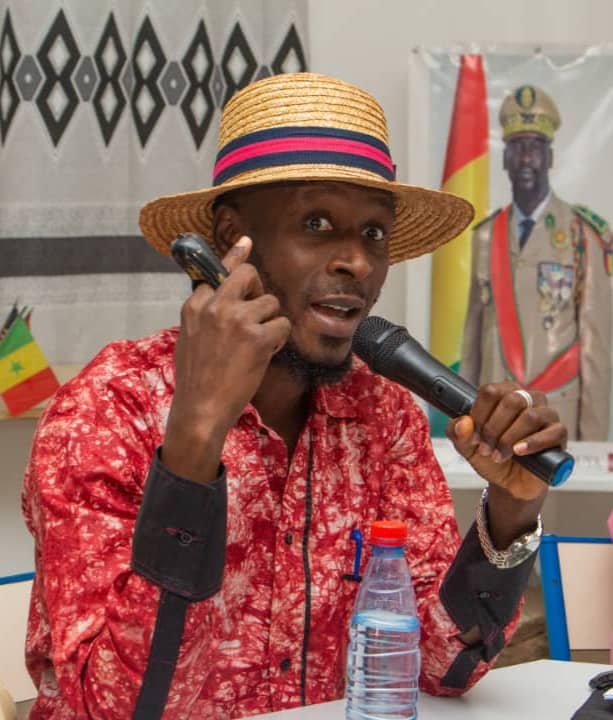
Sékou Jamal Pendessa, Secretary General of the Union of Press Professionals of Guinea (SPPG), who is my older brother, is a prominent figure in defending press freedom. He was arrested on January 19, 2024, simply for daring to defend the fundamental right to inform. His “crime”? Leading a peaceful mobilization against censorship and repeated violations of freedom of speech imposed by the ruling junta.
“It is high time that the leaders understood that, in a democracy, the media serve as both lighthouse and alarm bell to keep the country on the right track.”
Falsely accused of “disturbing public order”, he was sentenced to six months in prison, three of which were suspended, and fined 500,000 Guinean francs (about 70 USD) by the Dixinn Court of First Instance, with the clear aim of intimidating all those who refuse to remain silent.
In the face of this repression, the SPPG continues to defend freedom of speech at great sacrifice. Increasingly, the international community is being urged to ensure the junta honors its commitments on human rights and press freedom. As Sékou Jamal Pendessa reminds us, “It is high time that the leaders understood that, in a democracy, the media serve as both lighthouse and alarm bell to keep the country on the right track.”
A Climate of Fear and Self-Censorship
Any critics of the regime are systematically deterred and intimidated by the threat of legal proceedings for breaching the peace.
Fear has gripped newsrooms. Guinean journalists work under the constant threat of arbitrary arrest, physical violence, and even abduction. Habib Marouane, administrator of the website “Le Révélateur 224”, was brutally abducted on December 3, 2024, around 7 p.m. on the street by heavily armed police while on his way to a professional meeting in Lambanyi, a suburb of Conakry. Witnesses saw his vehicle violently stopped in Lambanyi, near the home of prominent businessman Kerfalla Person Camara (KPC), where Habib was headed. His windshield was smashed, and he was dragged from his car, beaten unconscious with a baton, and taken to an unknown location. Since that day, he has been missing with no sign of life.
On his news website, Habib had published a courageous article revealing that, after a thorough investigation, 156 people had died during the tragic event at the stadium in N’Zérékoré. He strongly called out the responsibility of the police and security forces. According to the official toll from the Guinean authorities, 56 people were killed.
Stade du 3-Avril Tragedy
The Stade du 3-Avril in N’Zérékoré, where the tragedy of December 1, 2024, occurred, is an aging stadium whose capacity was vastly exceeded during the final of the Rebuilding Tournament held in honor of the Head of State, General Mamadi Doumbouya. According to an independent report, thousands of people were in attendance, leaving the stadium dangerously overcrowded and well beyond its official capacity. This overcrowding was an aggravating factor in the deadly stampede that followed. The tragedy began after a disputed refereeing decision, which sparked anger among supporters and led to stone-throwing. Security forces then intervened by firing tear gas inside the stadium, officially to facilitate the exit of certain ministers who were in attendance.
Several witnesses and victims state that had the police not used tear gas, the human toll would have been far lower. Amnesty International stresses that tear gas should only be used as a last resort, a condition that, according to numerous testimonies, was not met in this case.
In the weeks leading up to his kidnapping, journalist Habib Marouane Camara had warned the public about the growing threats against him. His case poignantly illustrates the grave risks faced by journalists determined to expose endemic corruption and relentlessly denounce the military regime. His enforced disappearance tragically forms part of a disturbing pattern of abductions targeting key figures in civil society, including Oumar Sylla, Mamadou Billo Bah of the National Front for the Defence of the Constitution (FNDC), and former Secretary General of the Ministry of Mines, Saadou Nimaga.
Post-edited translation by Akansha Chartier and Luana Tournemine (M1 students in translation at ULB) under the supervision of Matthew Langsley